The Problems in the Industry
While many believe that the aviation industry should not dominate federal transportation funding and should go to other means of transportation, such as railroads and the highway system; the federal government must increase the funding to the Federal Aviation Agency, allowing them to properly hire and pay staff, such as air traffic controllers and to a more limited extent, ground crew, which would help reduce accidents due to understaffing, reduce mental health issues in staff, and improve airport infrastructure.
Learn more about the problems afflicting Air Traffic Controllers
│
│
│
V
Learn more about the issues afflicting airport ground crew.
│
│
│
V
Air Traffic Controller
Understaffing
Many aviation accidents occur due to the understaffing of key personnel, which can lead to overwork, which can lead to higher levels of stress or burnout, which has the potential to lead to accidents. According to Brookings, “The FAA employs around 11,000 certified professional controllers (CPCs), which is roughly 3,000 below the level needed” (Robyn). The lack of air traffic controllers causes the existing controllers to be overworked, which can lead to accidents. The situation is also continuing to worsen with the little number of new hired air traffic controllers. “From 2013 to 2023, the FAA hired only about two-thirds of the controllers called for by its staffing model” (Robyn). A large part of this problem is the high failure rate for controller trainees as “The failure rate for achieving full certification at individual facilities is going up, as is the time required to fully certify for the larger facilities that handle a significant share of commercial air traffic” (Robyn). Many trainees face difficulty in completing their training for a variety of reasons; a key part of the lack of new controllers not being hired is “getting trainees the time they need with senior controllers who are already stretched thin” (Robyn). Not only are these senior controllers unable to give the time needed to train trainees, but there is also a lack of willingness to, as many are overworked and suffer from stress or burnout. “A lack of former controllers willing to act as instructors, calling that the current “principal constraint” on bringing new controllers online” (Demirjan). The lack of controllers has been shown to have consequences, as many accidents can be attributed to the lack of controllers currently staffed, or the overworked controllers being unable to handle the situation.
Mental Health
Due to a severe lack of staff in the air traffic control industry, many of the overworked ATCOs suffer from mental health issues. According to Airport Technology, “A 2024 study reported that nearly 20% of ATCOs in the US and 13% of those in the rest of the world present moderate to severe anxiety levels” (Allan). Allan reports that many ATCOs go through a large amount of stress daily, and “These factors are also leading to an increase in the rate of ATCO burnout, which is only creating a feedback loop that’s worsening staffing gaps” (Allan). ATCO burnout decreases their ability to work, which further worsens the problem for other controllers who must take on the workload from their coworker, which could lead to faster burnout. “Adding to the issue is the fact that some ATCOs who may be struggling with their mental health will avoid asking for help” (Allan). Due to the FAA’s strict guidelines for mental health, an ATCO reporting they have a mental health problem may cause them to lose their clearance to do their job, which causes many to never report their issues.
Technology
[ This outdated technology may be one of the root causes of many accidents, as well as ATCO overwork. Many have shown light on this issue, including “A federal watchdog … saying that many are critically outdated and that the agency’s heavy reliance on them could jeopardize the safety and efficiency of the nation’s airspace” (Anderson). The FAA is unable to upgrade these outdated systems because of a lack of funding, but must continue to rely on them, despite their risks to safety. Specifically, “A Government Accountability Office evaluation of the F.A.A.’s 138 air traffic controller systems found that 51 are considered unsustainable, while another 54 are deemed potentially unsustainable” (Anderson). “It is safe to say that the real miracle is that there are very few accidents that can be traced to these faulty systems even though some are 50 years old and a large number of them are 20-30 years old” (Anderson). Despite the amount of accidents directly attributed to the aging systems, any accident that could be linked in any way to these systems could have been prevented if the systems were upgraded. Despite these systems being desperate for upgrades, the FAA has little to no plan to do so; “ Timetables for reinvestment in the systems won’t occur until 2030 at the earliest, if at all” (Anderson). These critical systems have little to no plans for modernization, as the lack of federal funding to the FAA prevents them from even planning for future upgrades.
Airport Ground Crew
Understaffing
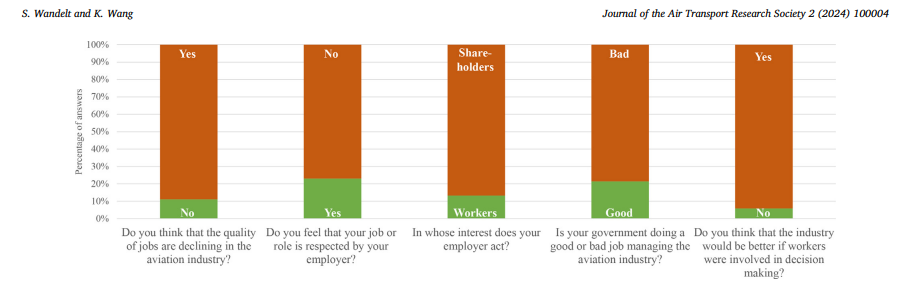
The airport ground crew are also a key part of the aviation industry, as they conduct many important jobs on a daily basis. However, they also experience staffing shortfalls, as exposed during the COVID-19 pandemic recovery, when, according to Wandelt and Wang, “various airlines and airports had to cut flights to reduce excessive delays, lost luggage, and other downstream effects, in absence of ground workforce sufficient to handle the rising travel demands” (Wandelt & Wang). Due to the lack of ground crew during the recovery period from COVID-19, many airlines struggled to keep up with the rising demand and were forced to cancel or delay flights. The issue of understaffed ground crew is also worsened by the fact that ground crew do difficult and strenuous work, which may drive away potential new hires. “The tasks of ground handling workforce is considered highly challenging, not only from a technical perspective, but also being at the intersection of all other aviation stakeholders” (Wandelt & Wang). The potential driving away of potential new hires prevents airlines from having the proper amount of manpower needed. In addition, many ground crew workers are dissatisfied with their job, as shown in “A survey in Summer 2022 revealed the high degree of dissatisfaction of aviation workers, leading to incentives for changing the job” (Wandelt & Wang). Many ground crew workers are not satisfied with their job, which can further drive away potential hires, which does not entice the employer to change their business practices. Both of these aspects of the aviation industry should be given attention, as both are key aspects that are suffering from issues.
You can read my full paper
WHAT CAN YOU DO?
Good question. If you want to make real change, use this template letter and send it to your local Congressman or woman. Use this letter to encourage them to bring forward motions that will help fund the FAA, and help these neglected employees.
Dear Representative [Last Name],
I am writing to bring your attention to a growing concern affecting the safety, efficiency, and reliability of our nation’s aviation system: the chronic understaffing and overworking of both air traffic controllers and ground crew personnel.
Across the country, air traffic control facilities and airport ground operations are facing significant staffing shortages. These shortages are placing an unsustainable burden on existing workers, many of whom are required to work extended hours, frequent overtime, and irregular schedules. While these professionals remain highly dedicated, the cumulative effects of fatigue and overwork raise serious concerns about operational safety and long-term workforce retention.
Air traffic controllers play a critical role in maintaining the safe and orderly flow of aircraft, and ground crews ensure that planes are serviced, loaded, and dispatched efficiently. When these teams are understaffed, delays increase, system resilience decreases, and the margin for error narrows. This is not simply an issue of inconvenience—it is a matter of public safety and national infrastructure reliability.
I respectfully urge you to support policies and funding initiatives that:
Increase recruitment, training, and retention efforts for air traffic controllers and ground personnel
Improve working conditions to reduce fatigue and burnout
Modernize workforce planning to better anticipate and address staffing needs
Ensure accountability and transparency in staffing levels and operational readiness
Investing in these areas will strengthen the aviation system, protect workers, and ensure the safety of the traveling public.
Thank you for your time and attention to this important issue. I would appreciate the opportunity to hear your thoughts on how Congress plans to address these challenges.
Sincerely,
[Your Full Name]
Why I Chose this Topic
Personally, my goal is to become a commercial airline pilot, and I want to ensure that the people that I work with are properly paid and are safe. When I work with them, ensuring that they are properly trained and taken care of is a large priority. In this industry, one of the paramounts is safety. Safety can be improved by further funding these airports. If everything is not completely safe, it can potentially put many lives at risk. Furthermore, I genuinely care about the wellbeing of others, and one part of this is properly paying these air traffic controllers, ground crew, and not overworking them. The kind of work conditions currently happening is what causes devastating accidents with large losses of life, and is exactly the kind of thing that I would like to prevent.